
A great property listing does more than show that a home is available. It helps buyers decide whether the layout fits their lives, whether the spaces feel inviting and whether a showing is worth their time. In 2026, that calls for a coordinated package of professional photography, clear floor plans and, where appropriate, immersive tours and video.
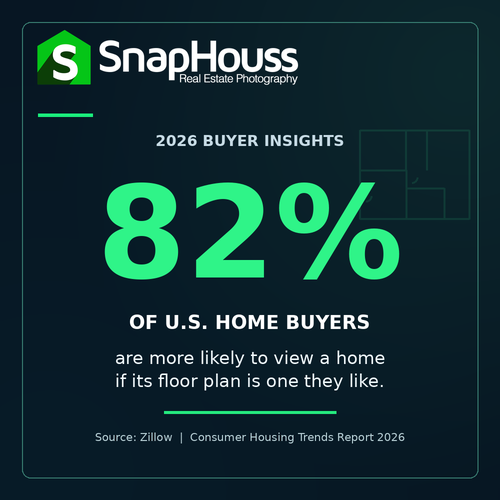
Zillow’s 2026 Consumer Housing Trends Report, published October 14, found that 82% of surveyed U.S. buyers said they were more likely to view a home if its listing included a floor plan they liked. Separately, 69% said 3D tours help them understand a space better than static photos. These are measures of buyer preferences—not proof that a particular media service increases a property’s sale price. [1]
Here is a practical, evidence-informed checklist for building a listing that answers buyers’ questions before they book a showing.
1. Start with professional real estate photography
Still photography is the foundation of most online listing experiences. Buyers need a strong first image and an honest visual tour of the property’s main spaces: exterior, living room, kitchen, bedrooms, bathrooms and any standout amenities. Consistent exposure, straight vertical lines and natural-looking colors help viewers understand the home without distracting editing.
The National Association of REALTORS®’ 2025 Profile of Home Staging found that 73% of buyers’ agents regarded photos as highly important to their clients. That survey reports agents’ perceptions, not a controlled test of sale outcomes, but it reinforces the importance of the basic photo package. [2]
Photo checklist: Lead with the home’s strongest representative view; show rooms in a logical sequence; include useful context such as entrances and outdoor space; remove temporary clutter; and verify that every edited image accurately represents the property. Avoid digitally removing permanent defects or altering views in ways that could mislead a buyer. Follow applicable MLS and brokerage rules for editing and disclosure.
2. Treat floor plans as essential information, not decoration
A beautiful photograph cannot fully explain whether the kitchen connects to the family room or how bedrooms are arranged. A readable floor plan helps answer those questions.
Zillow’s 2025 prospective-buyer research asked respondents to name the single most important listing feature. Floor plans ranked first at 33%, followed by high-resolution photos at 26% and 3D or virtual tours at 20%. This is a different survey question and audience from the 2026 buyer findings, so the percentages should not be combined or interpreted as a year-over-year trend. [3]
Floor-plan checklist: Label rooms clearly; distinguish levels; make doorways and circulation easy to follow; state whether dimensions are approximate; and confirm that any square-footage representation follows local measurement standards. In Canada, requirements can differ by province and listing system. For Alberta properties, confirm whether the applicable Residential Measurement Standard is required and use a compliant measurement workflow where necessary.
3. Use 3D tours to help buyers explore at their own pace
A 3D tour offers a different benefit from a video: viewers choose where to look and can revisit rooms in their own order. That can help relocating buyers, busy households and people narrowing a shortlist from a distance. It can also complement an in-person appointment rather than replace it.
In Zillow’s October 2026 survey of successful U.S. buyers, 63% wished more listings offered 3D tours, while 69% agreed that a 3D tour helps them get a better feel for a space than photos alone. Only 30% preferred 3D tours over in-person viewings, an important reminder that virtual media and physical visits serve different purposes. [1]
3D-tour checklist: Make the starting point intuitive; capture connected rooms completely; check navigation between floors; confirm that the tour works on mobile devices; and verify how long the tour will remain hosted. If hosting is subscription-based, understand the renewal and cancellation terms before publishing the link.
4. Give video a specific job
Photography lets a buyer inspect a room. Floor plans explain layout. A well-edited video can communicate movement, atmosphere and the flow between spaces. Short vertical edits may also be useful for social platforms, where viewers encounter a property before they actively search listing portals.
Video checklist: Open with the property’s strongest truthful feature; keep room transitions coherent; use music and captions appropriate to the channel; provide vertical and horizontal versions only when needed; and avoid claims that cannot be substantiated. Respect privacy, permissions and local advertising rules when people, neighboring homes or drone footage appear.
5. Prepare the property before the media appointment
Even excellent equipment cannot make a cluttered room feel organized. Before the shoot, open appropriate window coverings, turn on consistent interior lighting, secure pets, hide personal information and clear countertops. Check that beds are made, bathroom surfaces are clean and exterior landscaping is tidy.
Staging can help buyers understand how a space might function. NAR’s 2025 staging report found that 83% of buyers’ agents said staging made it easier for buyers to visualize a property as a future home. That does not establish a guaranteed return on staging costs, but it provides a sensible reason to focus preparation on the living room, primary bedroom and other spaces buyers will study closely. [2]
Where virtual staging is used, label it clearly and retain accurate unstaged imagery when required by the MLS or local rules. The goal is to make the listing informative and appealing—not to conceal the home’s actual condition.
6. Publish the assets as one coherent listing experience
A complete media package is only useful if buyers can find and use it. Upload images in a logical order; place the floor plan where it is easy to discover; test 3D links on desktop and mobile; and check that property websites, feature sheets and social posts show the same current details.
For a brokerage or property website, use descriptive image filenames and meaningful alternative text. Google’s Search Central guidance recommends relevant image context, descriptive filenames and useful alt text rather than keyword stuffing. For example, bright living room with sliding doors opening to a garden tells readers and search systems more than IMG_4821. [4]
7. Match the package to the property and the marketing plan
The right package depends on the home’s complexity, the target buyer and where the listing will be promoted. For a straightforward entry-level property, a complete photo set and accurate floor plan may cover the most important questions. For a large, architecturally unusual or relocation-oriented property, a 3D tour and video may provide additional context. Drone photography can help when the lot, waterfront, acreage or surrounding setting is material to the buying decision, subject to local aviation and privacy requirements.
For agents working across the U.S. and Canada, SnapHouss offers real estate photography, floor plans, 3D virtual tours and video services, with available bundles and add-ons varying by market. Explore SnapHouss service examples and current pricing and service terms before booking.
Frequently asked questions Are professional photos or floor plans more important in 2026?
They answer different questions. Photos communicate appearance and condition; floor plans clarify space and room relationships. In Zillow’s 2025 survey of prospective U.S. buyers, more respondents chose floor plans than photos as their single most important listing feature. A practical listing should generally include both. [3]
Do 3D tours replace in-person showings?
Usually not. Zillow’s 2026 U.S. buyer research found substantial interest in 3D tours, but only 30% of respondents said they preferred them to in-person viewings. Think of tours as a way to help buyers evaluate and prioritize properties. [1]
Does professional listing media guarantee a higher sale price?
No. Final sale outcomes also depend on pricing, property condition, location, supply, demand and negotiation. Quality media can make a listing clearer and more compelling, but survey preferences should not be presented as proof of a specific price increase or faster sale.
The bottom line
The most useful 2026 listing strategy is not to add every possible marketing asset. It is to build a truthful, accessible and coordinated presentation: strong professional photographs, a readable floor plan, and targeted video or 3D experiences where they genuinely help buyers understand the property. When those pieces work together, agents can give prospective buyers better information and a more confident starting point.
Research sources
Zillow Research, Buyers: Results from the Consumer Housing Trends Report 2026 (October 14, 2026): https://www.zillow.com/research/buyers-housing-trends-report-2026/
National Association of REALTORS®, 2025 Profile of Home Staging: https://www.nar.realtor/research-and-statistics/research-reports/profile-of-home-staging
Zillow Research, Prospective Buyers: Results from the Consumer Housing Trends Report 2025 (December 17, 2025): https://www.zillow.com/research/prospective-buyers-consumer-housing-trends-2025/
Google Search Central, Image SEO Best Practices: https://developers.google.com/search/docs/appearance/google-images
Editorial note: Zillow and NAR survey findings cited here are U.S.-based. Recommendations for Canadian listings are general practice suggestions, not claims that U.S. survey percentages represent Canadian buyers.
Additional internal linking suggestions: 3D virtual tour explainer and Why real estate photography matters.
